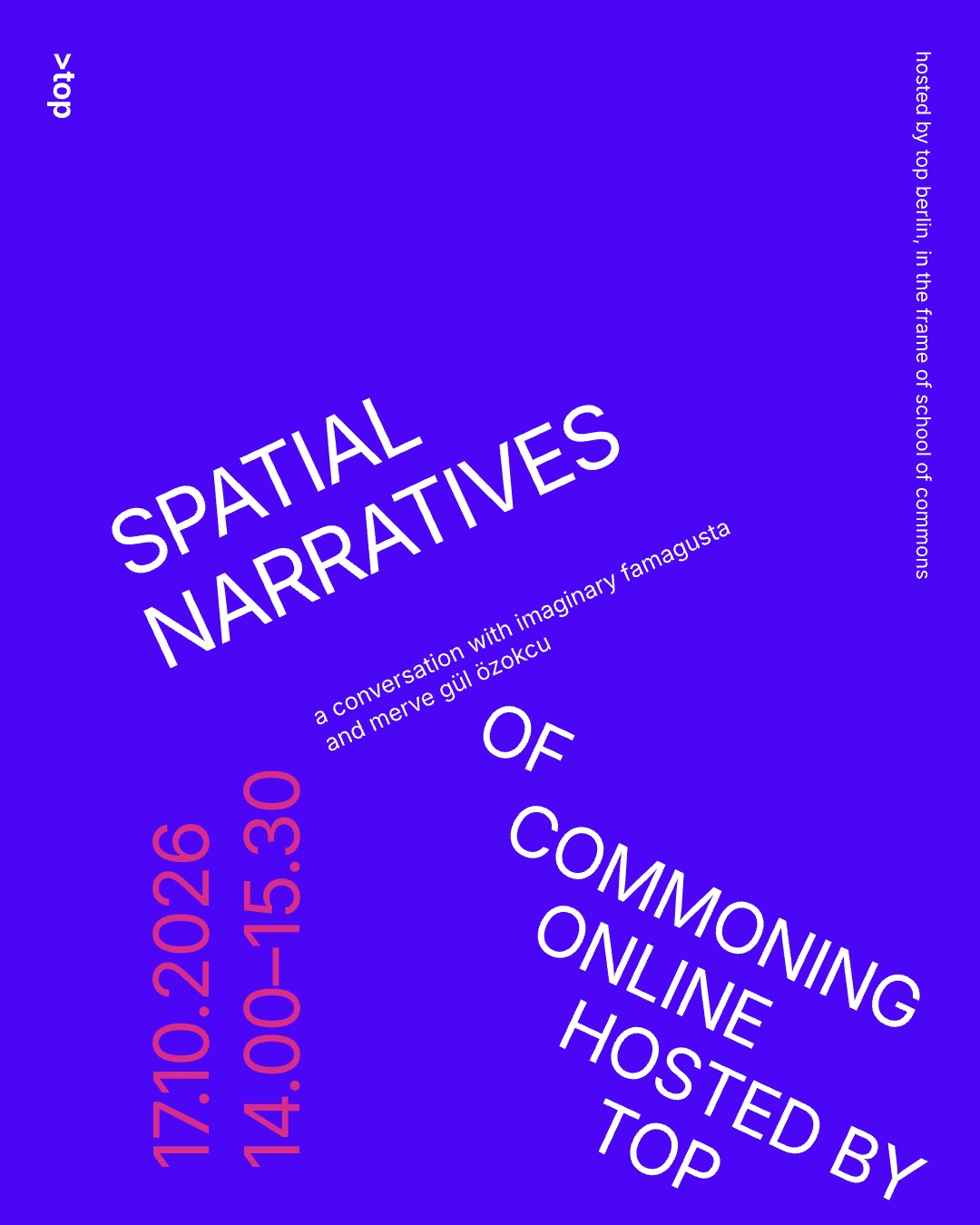
A conversation with Imaginary Famagusta and Merve Gül Özokcu
Saturday 17 October 2026, 14:00–15:30 (Berlin)
13:00 London · 15:00 Istanbul
Online, in English
Moderated by Melissa Harrison and Yelta Köm
How do people make something in common when the ground under them has been divided, closed off or abandoned?
The programme’s first public conversation brings together two practices that build common ground on contested land: Imaginary Famagusta, working across the divided city of Famagusta in Cyprus, and Merve Gül Özokcu, working with residents, students and villagers across Turkey.
Each practice presents its work, followed by a conversation moderated by Melissa Harrison and Yelta Köm and questions from the audience. An edited version will become part of ISSUES 2026, the School of Commons publication.
Imaginary Famagusta
Imaginary Famagusta (or “IF”, comprised of Socrates Stratis, Emre Akbil, Esra Can, Munevver Ozgur Ozersay and Lara Scharf) developed imaginaries of future commons to turn conflict into urban questions and generate debates involving Greek Cypriot and Turkish Cypriot communities in Famagusta, a city divided for the past 52 years. Their earlier project Hands-on Famagusta was published as Guide to Common Urban Imaginaries in Contested Spaces (Jovis, 2016).
Merve Gül Özokcu
Merve Gül Özokcu is an architect, researcher and activist based in Istanbul, working at the intersection of the commons, eco-feminist narratives and spatial justice. Through Herkes İçin Mimarlık (Architecture for All), she has co-led participatory, long-term and proactive on-site interventions addressing political and ecological urgencies through collective action across Turkey.
Merve is part of Arazi Assembly, a research collective based in southeast Anatolia, focusing on decolonial, care-driven knowledge practices. Her academic work explores alternative pedagogies and the performativity of architecture as a site of power, precarity and resistance.
Her projects, including Occupy Gezi Architecture, Women Narrative Spaces and The Revitalisation of Abandoned Rural Schools, have been shared in contexts ranging from international institutions to rural commons.
About the programme
Spatial Narratives of Commoning is a research programme by Melissa Harrison and Yelta Köm, hosted by TOP e.V. in Berlin. This year it takes part in the School of Commons, a peer learning programme initiated by the Zurich University of the Arts (ZHdK).
It asks how spatial practices can respond to displacement, ecological crisis and social marginalisation, and what kinds of places emerge from solidarity, memory and repair.
Hosted by TOP e.V., in the frame of School of Commons (ZHdK).