A hybrid hands-on workshop series by Xristina Sarli with guest collaborator Christos Kourtidis
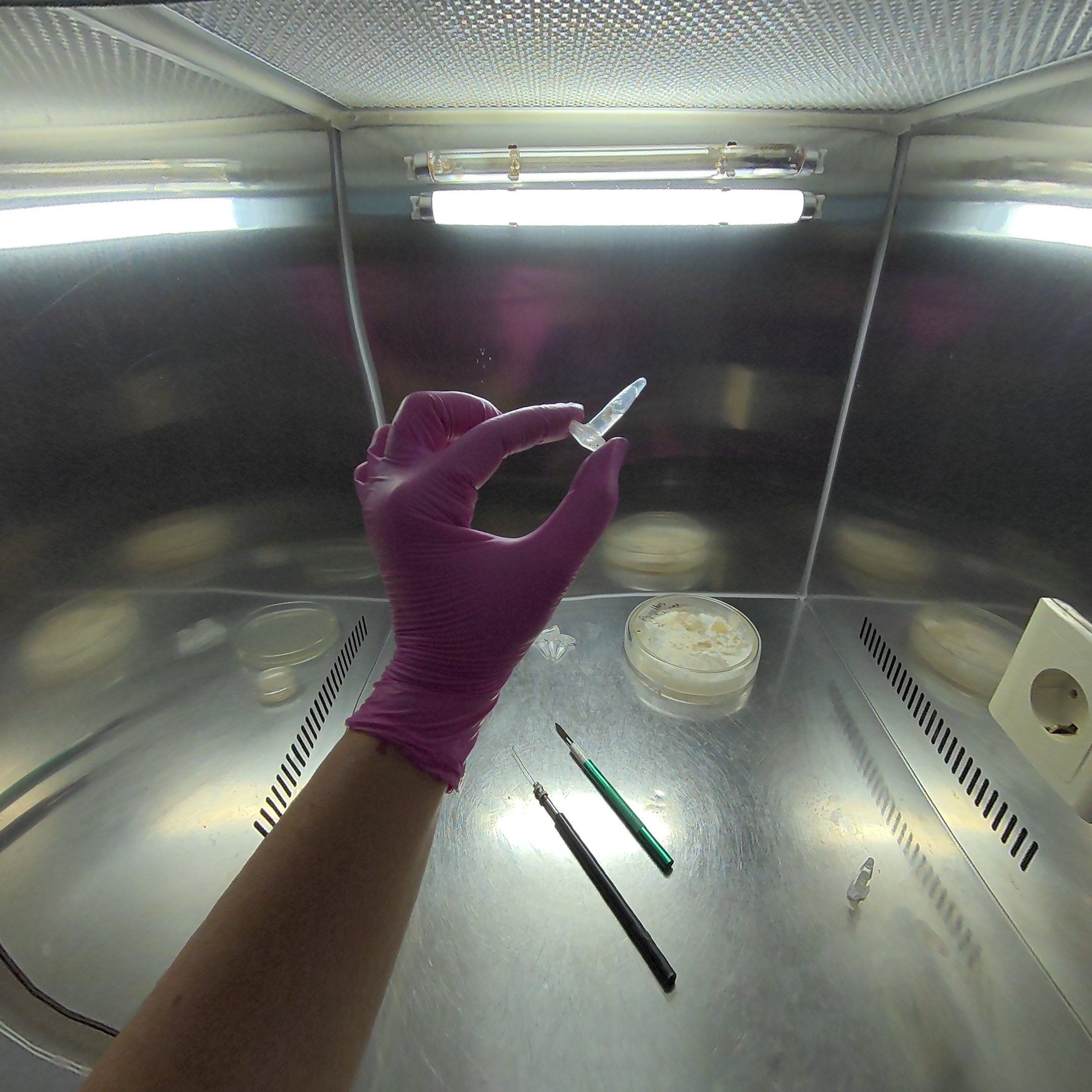
Mycohacking the Future presents: Digital to Mycofabrication is a hybrid hands-on workshop by Xristina Sarli with guest collaborator Christos Kourtidis, exploring how mycelium cultivation, biomaterials, and 3D printing can support more ecological fabrication practices. Participants will learn the process from mushroom-based material cultivation to digitally supported design objects, moving between DIY biology, sustainable making, and speculative ecological futures.
Mycohacking the Future is a workshop series exploring the role of fungi in ecological futures: how mushrooms, mycelium, and biomaterials can move across art, design, science, technology, and everyday practices.
For this edition, Digital to Mycofabrication, Xristina Sarli invites Christos Kourtidis as a guest collaborator to co-create a practical framework around mycelium cultivation, digital fabrication, and 3D printing with biomaterials.
Together, they will guide participants through the process from the ground up: how to cultivate mushroom-based materials, how mycelium can be used in design objects, and how digital tools can support more ecological fabrication methods.
The workshop follows two parallel streams:
1. Mycelium cultivation and mushroom materials
We will introduce the basics of cultivating fungi for material processes using low-risk, food-grade approaches that can also be understood outside of a professional lab context.
2. Digital fabrication and biomaterial design
We will look at how 3D printing, biodegradable or bio-based filaments, and digitally fabricated structures can become part of a sustainable design workflow.
Dates
Wednesday, 8 July 2026
12:00–15:00 · Introduction to mycelium cultivation and mushroom materials
15:00–16:00 · Break
16:00–19:00 · Introduction to digital fabrication, 3D printing, and biomaterial design
Tuesday, 14 July 2026
12:00–15:00 · Continuation of the cultivation and fabrication process, with further design development, material work, and discussion.
15:00-16:00 · Break
16:00–19:00 · Collective assembly, form release, and final presentations
The full detailed program will be shared with registered participants by the beginning of July, once all material details are confirmed.
Participation
There are two ways to join:
Hands-on participation
For participants who want to work directly with the materials, create objects, and take their experiments home.
Suggested donation: 30–60 €, depending on capacity.
Open participation / discussion
For anyone curious about the topic who would like to attend, listen, discuss, and be present, but cannot cover material costs. We want to keep the workshop accessible and encourage people to join according to their capacity.
No previous lab, biology, or 3D printing experience is required — only curiosity, patience, and an interest in ecological futures.
About
Christos Kourtidis is by profession an interdisciplinary designer and interior architect, and a PhD researcher at the University of West Attica, Greece. His research within the framework of spatial and product design focuses on the intersection of biodesign, biomaterials, aesthetic customization, and circular economy.
LinkedIn: linkedin.com/in/christos-kourtidis-646298108
Xristina Sarli is a hybrid curator, artist, and researcher working at the intersection of ecology, bioart, and immersive technologies. As co-director of Top Lab, Berlin’s first DIY biolab, they engage in experimental biological practices and transdisciplinary research centered on multispecies collaboration and regenerative systems.
An award-winning animator and 3D/XR artist, Sarli creates installations and performances that function as living interfaces.
Their background in game art and immersive media informs a practice that understands ecology as multiplayer, a system of negotiated alliances where more-than-human agencies actively shape shared worlds.
Website: https://xristinasarli.com/
Instagram Handle: @xristinasarli